
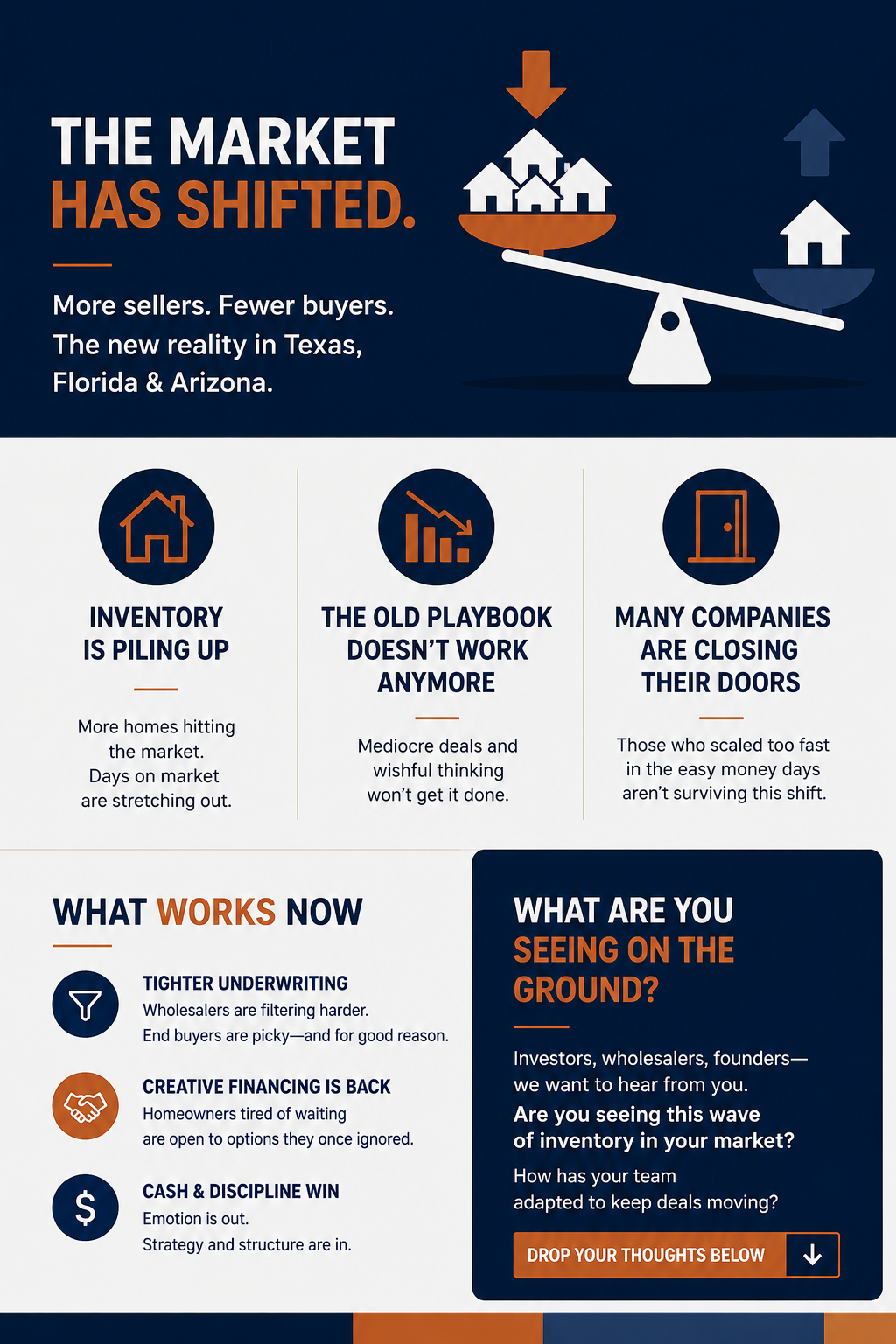
If you have been keeping a close eye on the housing market across high growth Sunbelt metros like Texas, Florida, and Arizona, you have likely noticed a major psychological and statistical shift.
For the first time in years, the numbers are staring us right in the face because there are simply more people trying to sell homes than there are active buyers stepping up to purchase them.
For anyone watching the headlines, the immediate reaction is panic.
But if you are a real estate investor, wholesaler, or operator building a business in these regions, this is not a market crash.
It is a long overdue market correction.
The low margin easy money era of the post pandemic boom is officially behind us.
Here is what is actually happening on the ground across the Sunbelt, why undercapitalized companies are quietly closing their doors, and how smart operators are adapting their strategies to win.
The Death of the Easy Money Playbook
During the hyper competitive seller market of recent years, almost any contract could be flipped with minimal effort.
Wholesalers could lock up an average single family property at a slim discount, throw it on a buyers list, and watch retail flippers or landlords enter a bidding war.
That playbook no longer works.
With inventory piling up and days on market stretching out in cities like Austin, Houston, Phoenix, and Miami, end buyers are sitting on their hands.
They are hyper selective, demanding better margins, and refusing to overpay for mediocre deals.
Under capitalized real estate companies that scaled too fast and relied on sloppy underwriting are finding out the hard way that the market has changed.
If your numbers are not airtight, your contracts will sit right alongside overpriced retail listings.
Why Creative Finance Is Taking Center Stage
Traditional homeowners in the Sunbelt are feeling the pinch.
Between rising property insurance costs, higher carrying fees, and longer wait times to find a retail buyer, frustration is setting in.
Sellers who would not have given alternative solutions a second glance a couple of years ago are suddenly wide open to conversation.
This has created a massive window of opportunity for investors utilizing creative financing strategies.
Subject To Transactions: Taking over existing low rate mortgages is becoming an essential tool for relief seeking sellers.
Seller Financing and Hybrid Terms: Frustrated retail sellers are increasingly willing to act as the bank to get their properties moved.
Creative finance is no longer just a niche strategy used by advanced investors. In today high inventory Sunbelt environment, it is rapidly becoming the primary mechanism to get deals across the finish line.
Cash and Diligence Rule Again
For years, investors were forced to waive inspections, overlook structural flaws, and overpay just to win a deal amidst waves of competition.
Today, the power has shifted entirely back to capital and discipline. Investors with liquid cash no longer have to compete in frantic twenty offer bidding wars.
They can take their time, perform proper due diligence, demand seller concessions, and structure acquisitions around terms that protect their downside.
Moving Forward: Adapt or Exit
The current shift in Texas, Florida, and Arizona real estate is shaking out the order takers and leaving room for true operators.
By tightening underwriting standards, leaning into direct to seller marketing, and offering creative financing solutions to frustrated homeowners, active investors can turn this inventory surge into their biggest advantage yet.
What are you seeing in your local market?