
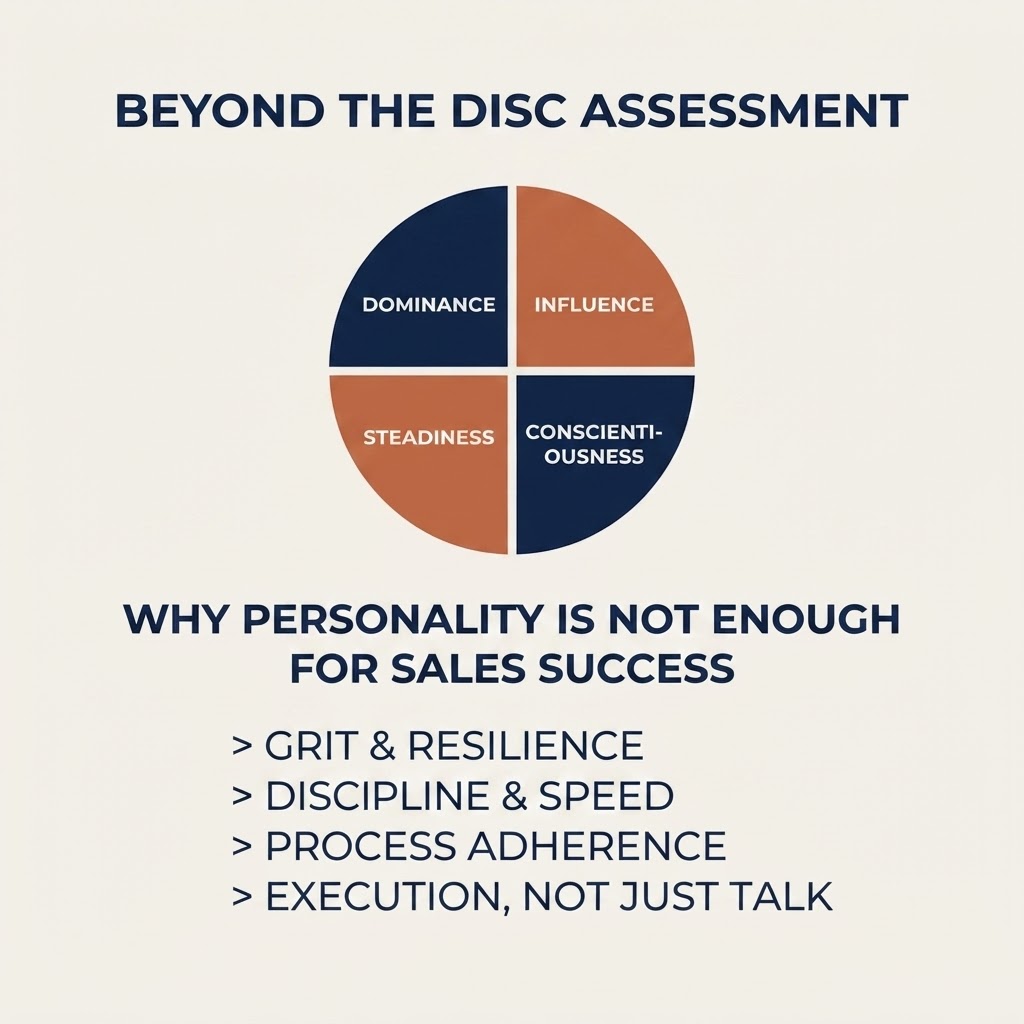
Every time you talk to founders about scaling a sales team, someone inevitably brings up the DISC assessment.
It is a classic piece of hiring folklore.
Everyone wants that magic test to tell them with absolute certainty whether a candidate is going to crush quota or flame out by week two.
But if you treat a DISC score like a crystal ball, you are going to end up with a team of high scoring talkers who cannot actually execute when the rubber meets the road.
Understanding what those personality types mean is important, but knowing where behavioral frameworks fall short is what separates high performing organizations from struggling call centers.
The DISC Breakdown: What the Letters Actually Mean for Sales
Before looking at how to build an engine around hiring assessments, we have to look at the baseline behaviors:
Dominance or D profiles are direct, competitive, and wired to win. They are built for high stakes closing and aggressive targets.
Influence or I profiles are outgoing, energetic, and genuinely fond of people. They are natural fits for cold calling and front end outreach where initial human connection drives momentum.
Steadiness or S profiles are patient, reliable, and deeply value stability.
They often struggle with the brutal, hourly rejection of cold outbound, but they shine in account management or disposition roles where empathy and consistency matter.
Conscientiousness or C profiles are analytical and detail oriented.
They usually find aggressive sales environments draining because they would rather deal with hard data than cold pitching strangers.
Do High I and D profiles fit sales better on paper? Generally, yes. But here is the catch: DISC only gives you a baseline.
The Flaw of Hiring by Personality Alone
A behavioral test tells you how someone naturally communicates and processes information.
It does not tell you whether they can build a pipeline, handle fatigue, or stick to a framework.
If you hire based on personality alone, you miss the entire operational engine.
A great score means nothing without the actual drivers of real world performance:
Great communication under pressure, meaning can they articulate value clearly when a prospect pushes back?
Discipline and speed, meaning do they maintain high output and momentum when nobody is micromanaging their hours?
Resolution, meaning can they actively navigate friction to drive an interaction toward a definitive yes or no?
Standard Operating Procedure or process adherence, meaning do they follow the tested playbook, or do they freestyle and break the system?
The Takeaway
DISC tells us whether a candidate fits the operational seat. But execution, grit, and strict process adherence are what actually close the deals.
The assessment is merely a starting point. A candidate's internal work ethic and engine are what ultimately drive the results.
How much weight do you currently give to behavioral assessments versus raw execution when you are building your team?